
Investing in the equities either through Stocks or via Mutual Funds involves risk, but the method & mode of investment can also significantly impact your returns. Let's analyze two common investment strategies, Systematic Investment Plan (SIP) and Lump sum investment, using the 2008 global financial crisis as a case study.
Imagine you invested right before the crash – which strategy would have fared better? Let's look at the graph below which shows how your investment would have performed in case of a one-time lump sum investment in mutual funds vs following a SIP (systematic investment plan) method of investment throughout the tenure i.e. from 1st Jan 2008 till 28th Feb 2025. (The returns are represented using Nifty TRI Indexes)
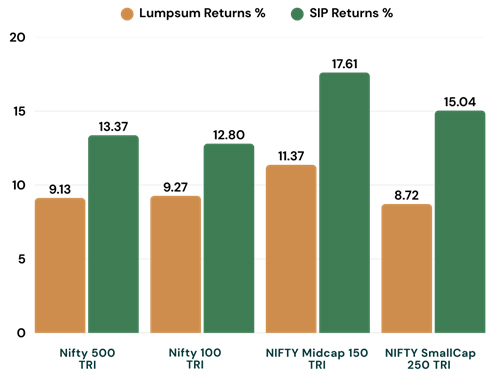
Assume both SIP and Lumpsum investments were initiated just before the 2008 global financial market crash. The market subsequently plummeted, causing significant losses for many investors.
While a Lump sum investment would have suffered a substantial immediate loss in 2008, the SIP investor would have continued investing during the market downturn. This is where the magic of rupee-cost averaging comes into play. By buying more units at lower prices, the SIP investor's average cost per unit decreased significantly. When the market eventually recovered, the SIP investment would have yielded better returns compared to the Lumpsum investment, even though the Lump sum investor had a larger initial investment.
In essence, SIP allows you to turn market volatility into an advantage.The 2008 global financial crisis provides a valuable lesson about investment strategies. While Lump sum investments can be rewarding, SIP offers a more balanced approach, especially
during volatile periods. By investing systematically, you can weather market storms and potentially achieve better long-term returns. This post compared the performance of SIP versus Lumpsum investments in the context of the 2008 financial crisis. SIP's ability to average out the purchase price and continue investing during market downturns was highlighted as a key factor in its outperformance.
Disclaimer: All views on this article/blog are of our own and do not represent the opinions of any entity whatsoever with which we have been, am not and will be affiliated. This article/blog has been prepared solely for information purpose and should not be construed as an offer to buy or sell or a solicitation of an offer to buy or sell any security or any instrument or to participate in any transaction or trading activity. The contents are based upon or derived from information generally believed to be reliable although no representation is made that it is accurate or complete. Investments are subject to market risks, read all scheme related documents carefully. Past performance may or may not be sustained in the future. Investors should always invest according to their risk profile and consult with their mutual fund distributors or financial advisor before investing.